


Description
Street Medicine (TECC) Course
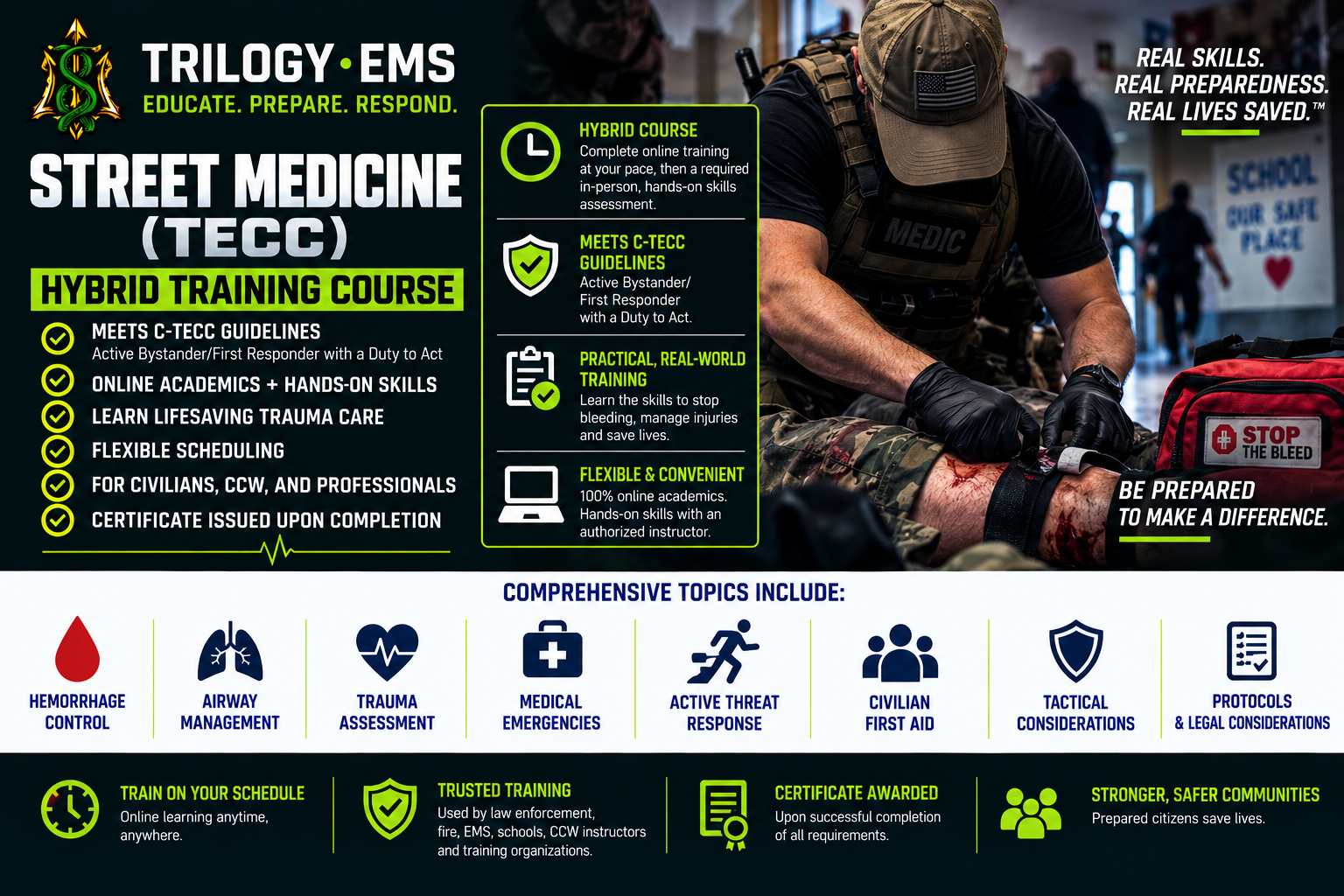
The Street Medicine (TECC) Course prepares individuals to recognize life-threatening traumatic injuries, take immediate action, and provide lifesaving care during the critical minutes before EMS can reach the patient.
Built around the principles of Tactical Emergency Casualty Care (TECC), the course is designed to meet the Committee for Tactical Emergency Casualty Care (C-TECC) educational guidelines for Active Bystanders and First Responders with a Duty to Act.
Street Medicine is applicable far beyond tactical environments. The same principles used to manage casualties during active-threat incidents can be applied to motor vehicle crashes, workplace injuries, recreational accidents, falls, penetrating trauma, severe bleeding, and other traumatic emergencies.
Students can choose between two training options based on the level of education and certification they need.
CHOOSE YOUR TRAINING OPTION
Awareness — Online Only
Complete the Street Medicine (TECC) academic program 100% online and at your own pace.
The Awareness option provides comprehensive education in TECC principles, casualty assessment, hemorrhage control, airway and respiratory emergencies, shock, trauma management, and the priorities of care during high-threat and everyday emergencies.
Upon successful completion of the online course, students receive a Certificate of Completion.
This option does not include hands-on practical training or skills assessment and does not result in full Street Medicine (TECC) certification.
Full Certification — Online + Hands-On
The Full Certification option combines the complete Street Medicine (TECC) online academic program with in-person, hands-on practical training and skills assessment conducted by an authorized Street Medicine instructor.
Students apply the principles learned online through practical skill stations and demonstrate competency in the lifesaving interventions taught during the course.
Successful completion of both the online academics and required hands-on practical training and assessment results in full Street Medicine (TECC) certification.
WHAT YOU WILL LEARN
Street Medicine focuses on the rapid recognition and treatment of preventable causes of traumatic death and teaches students how to make effective decisions when time, resources, and access to conventional emergency medical care may be limited.
Course topics include:
- Principles and priorities of Tactical Emergency Casualty Care (TECC)
- Active Bystander and First Responder with a Duty to Act concepts
- Threat-based priorities of care
- Rapid casualty assessment and reassessment
- Recognition and control of life-threatening hemorrhage
- Tourniquet application
- Wound packing and pressure dressings
- Airway assessment and management
- Recognition and management of respiratory emergencies
- Recognition and management of shock
- Hypothermia prevention
- Recognition of serious traumatic injuries
- Casualty movement and evacuation considerations
- Communication and documentation
- Providing care when EMS response or access may be delayed
- Applying TECC principles to both high-threat and everyday traumatic emergencies
MORE THAN ACTIVE-SHOOTER TRAINING
Although TECC principles are particularly important during active-shooter, violent-threat, and mass-casualty incidents, Street Medicine is not limited to tactical situations.
The principles taught in this course can be applied whenever serious trauma occurs.
A vehicle crash, workplace accident, shooting, severe laceration, recreational injury, fall, or other traumatic event can place an ordinary person in a position where immediate action may determine whether someone survives long enough for EMS to arrive.
Street Medicine provides a systematic approach for recognizing those threats to life and taking appropriate action.
WHO SHOULD TAKE THIS COURSE?
The Street Medicine (TECC) Course is appropriate for Active Bystanders, First Responders with a Duty to Act, public-safety professionals, and members of the community who want to be better prepared to respond to traumatic emergencies.
The course is well suited for:
- Law enforcement officers
- Firefighters and EMS personnel
- Security and armed security personnel
- School teachers, administrators, and staff
- School and campus safety personnel
- CCW/concealed carry permit holders
- Responsible armed citizens
- Firearms instructors
- CCW instructors
- Tactical firearms instructors and students
- Shooting range personnel
- Church and faith-based security teams
- Workplace emergency response teams
- Coaches and recreational personnel
- Community organizations
- Individuals who want practical trauma-response training
IDEAL FOR FIREARMS AND CCW TRAINING
Street Medicine is particularly well suited for firearms instructors, CCW instructors, shooting ranges, and tactical training organizations that want to incorporate lifesaving trauma education into their existing programs.
Firearms safety extends beyond preventing an incident. Students should also understand what to do when a traumatic injury occurs.
Street Medicine provides a structured TECC-based curriculum that can complement CCW, defensive firearms, tactical firearms, personal protection, and range training by teaching students how to recognize and respond to immediately life-threatening injuries.
COURSE COMPLETION
Your completion requirements depend on the training option selected at registration.
Awareness — Online Only:
Complete all required online course content and assessments. Successful students receive a Certificate of Completion. Hands-on practical training and full certification are not included.
Full Certification — Online + Hands-On:
Complete all required online course content and assessments plus the required in-person hands-on practical training and skills assessment with an authorized Street Medicine instructor. Successful completion of all requirements results in full Street Medicine (TECC) certification.
BE PREPARED WHEN MINUTES MATTER
Professional emergency responders cannot always reach an injured person immediately. During an active threat, serious accident, workplace injury, or everyday traumatic emergency, the person already on scene may be the only person capable of providing lifesaving care during the first critical minutes.
Street Medicine (TECC) teaches you what to recognize, what to do, and how to act when someone’s life may depend on the care provided before EMS arrives.